Roller Coaster Physics
Building Background
1. Have you ever been on a roller coaster? What forces do you think are acting on you?
4 The Golden age (1920)
7. G-forces are used for explaining the relative effects of centripetal acceleration that a rider feels while on a roller coaster.
a. Go to the link G-Forces (above in red), then find the section titled Blood Pressure . How many G's can a person handle before passing out?
b. What does Zero G's mean?
loops
8. Describe what a clothoid loop is and explain why it is used in place of the traditional circular loop.

Go to the app Air coaster and make your own roller coaster using your knowledge of the forces of physics.
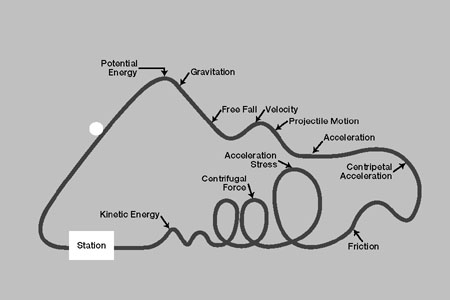
10.Look at the picture of the roller coaster below. Keep in mind these forces acting on the roller coaster. Draw the rollercoaster that you design and correctly lable the forces acting on your rollercoaster. Include friction forces, potential and kinetic energy, G- forces, gravity, free fall, velocity, acceleration, and centripetal force.